Government programs - Priority Program (Pembangunan Manusia dan Pembangunan Infrastruktur)
Government programs - Priority Program (Human Development Index and Infrastructure Development)
Human Development Index (IPM)

What is the Human Development Index? (IPM)
- IPM was introduced by UNDP in 1990 and published periodically in the annual Human
- IPM explains how people can access development outcomes in obtaining income, health, education, and so on.Development Report (HDR)
Concept:
- Human Development is a process which aims to have more choices, especially in income, health and education. Human Development as an overall measure of development performance is shaped through a three-dimensional approach. These dimensions include; long and healthy life; knowledge; and decent life. Each dimensions are represented by their own indicators.
- The main goal of this development is to create an environment which enable the people to enjoy a long, healthy and productive life, ~stated by UNDP~
- Human development is a process of enlarging people’s choices
Benefits:
- Human Development Index is a necessary indicator to measure the improvement in human life quality
- HDI can determine the levels of development of each country
- For Indonesia, HDI is a strategic data, since it not only is being a measure for the government's performance, it is also used as one of the allocators of the General Allocation Funds/Dana Alokasi Umum.
Examples:
- Replacing counterfeit news with qualified news
On the 2nd of May 2017, President Jokowi visited the remote area where he had read a story to the kids in the villages hoping that by doing so, the people would there would be more clever, wiser, and open up their view and insight of the world through knowledge gained from books. Nowadays, people are giving out hoax information, and therefore, Indonesia should be able to tell which one is fake and real information. This also helps improve their morality, ethics, honesty, politeness, and courage as it has been embedded since a young age. Since the story that was read to the children by the president was a story filled with imaginations, it would increase the children’s creativity, which is a part of intelligence, and therefore would devise an innovation, and new creation, for new technology and systems are created through imagination. In addition to that, these stories also contain noble values such as enthusiasm in gaining achievement, optimism, resilience, discipline, responsibility, and the will and courage to change one's fate. With their morality improved, the children will have more tolerance towards one another, be more compassionate, learn mutual cooperation and unity as well as togetherness. The president thinks that stories and fairy tales are good ways to implement a good natured personality for the kids by letting them absorb the good factors of the story subconsciously. By reading, our mind would be more open to new information such as; various cultures from different countries, understanding the values which are to be preserved, etc. The children would also be able to think critically. This way, even though children would be very attached to gadgets, they would also be a friend of books.
- Reinforcing the Pancasila Ideology
Pancasila is the heart of our nation. It is what had given us hope in uniting the nation to reach our independence in the past, but now it seems that it has been contaminated by promoting differences which should be embraced rather than mocked. In the past, Indonesia had different nations with different cultures, pasts, and languages, yet it managed to be bound together in a single culture, homeland and language, as the Indonesian Country. President Jokowi said that problems that happens in other countries are far worse than problems which happens in Indonesia because Indonesia is lucky to have Pancasila as its nation’s core. Bhinneka Tunggal Ika, meaning unity amidst diversity, meaning that Indonesia is a very tolerant country. Nowadays, Indonesia is torn apart between terrorism, radicalism and intolerance. In the past, President Soekarno said that “It doesn’t matter your race, or skin color since we are all in the guidance of one true God. He also said that our nation expresses all of our noble values and therefore presents a positive nationality, not only negative. Everything that we have been through would prove that if we change our nation’s core now, it would be a stepback for our country.
- Governments efforts to increase employment rates
To decrease the country’s rate of unemployment, the best way is to increase the economic growth of the country itself. To do this, the government must:
First; to create the locomotive of the job opportunities, we have to encourage the infrastructure development.
Second; increase investment. We can do this through license simplification and providing investment means
Third; encouraging vocational education for the government would create a job opportunity based on that type of education
Four: allocate the village’s funds
The changes of IPM’s methodology
1990 (Launching):
The component of IPM were used by AHH, AMH, PDB per capita. The aggregation method uses the arithmetic average/mean.
1990 (Launching):
The component of IPM were used by AHH, AMH, PDB per capita. The aggregation method uses the arithmetic average/mean.
1991 (Improvement):
IPM’s component were used by AHH, AMH, RLS, PDB per capita.
1995 (Improvement):
IPM’s component were used by AHH, AMH, and the combination with APK, and PDB per capita.
2010 (UNDP changes the methodology):
IPM’s component were used by AHH, RLS, HLS and PNB per capita. The aggregation method uses the geometric average/mean.
2011 (Improvement):
Replacing the base year of PNB per capita from 2008 to 2005.
2014 (Improvement):
- Replacing the base year of PNB per capita from 2005 to 2011.
- Change the aggregation method of educational index from geometric average/mean to arithmetic average/mean.
Infrastructure Development
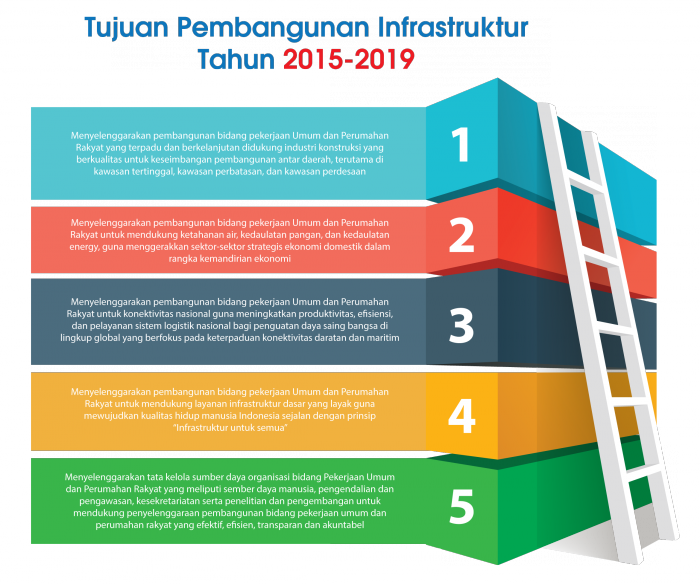
Concept:
Infrastructure development is the process of accelerating economic growth outside Java for justice and the act of evening out the development aimed at creating social justice and income of our citizens. The main goal is to improve many infrastructures, starting from highways, railroads, seaports, airports to markets.
Examples:
- Sophisticated Transport Project in Indonesia; Mass Rapid Transit (MRT): The cooperation project with the Government of Japan has an investment value of around 12 trillion rupiahs. This MRT will run through elevation and underground. For the Elevated MRT has reached 43 percent while the underground MRT has reached 78 percent. This construction is expensive due to the complexity of the technology used. In addition, the money is mostly invested for land acquisition. It is estimated that this will become the mainstay of transportation mode of Jakarta citizens.
- Sophisticated Transport Project in Indonesia; Light Rail Transit (LRT): LRT has a smaller transportation category, It is done by domestic companies, such as PT Adhi Karya (Persero) Tbk. Currently, this state-owned construction company is building a LRT line for the first phase, namely for Cibubur-Cawang route, which required Rp 2.5-3 trillion. Main director Adhi Karya Budi Harto has said that his progress reached 17 percent in early 2017.
History of how this program was made:
In the early days of Jokowi-JK’s government system that started on the 20th of October 2014, the issues of injustice and uneven infrastructure development were still going on. This can be seen from the various physical infrastructure development projects centered on the island of Java, therefore bringing up the term Java-centric development. The contribution of economy development calculated based on “Produk Domestik Bruto (PDB)” was still very weak between Java and areas outside of Java. In 2014, Java’s “Produk Domestik Bruto (PDB)” contribution reached 57.5%, meanwhile 42.5% came from areas outside of Java, and only 10.6% came from the Eastern Region of Indonesia. The impact was also reflected in human development. The data that was retrieved from the Ministry of Education and Culture in 2013/2014 shows that there are 68,584 schools primary schools in Java, which was more than the number of primary schools in Sumatra (35,125 primary schools), Sulawesi (15,872 primary schools), Bali and Nusa Tenggara (10,365 primary schools), and Maluku and Papua (6,413 primary schools). Meanwhile, the data of health facilities in the form of puskesmas in 2013, based on “Badan Pusat Statistik” shows that there were 3,574 health facilities in the form of puskesmas in Java as of 2013, which was more than the number of health facilities in the form of puskesmas in Sumatra (2,498 puskesmas), Sulawesi (1,253 puskesmas), Kalimantan (881 puskesmas), Papua (849 puskesmas), and Bali and Nusa Tenggara (640 puskesmas). President Jokowi realized that this condition needed to be changed, and so he ended the Java-centric orientation and replaced it with the Indonesia-centric orientation. This commitment was first proposed in Surabaya on the 10th of November 2015, which was also the same day as National Heroes Day. That day can be marked as one of the reasons for Indonesia’s revival in 2016.


Comments
Post a Comment